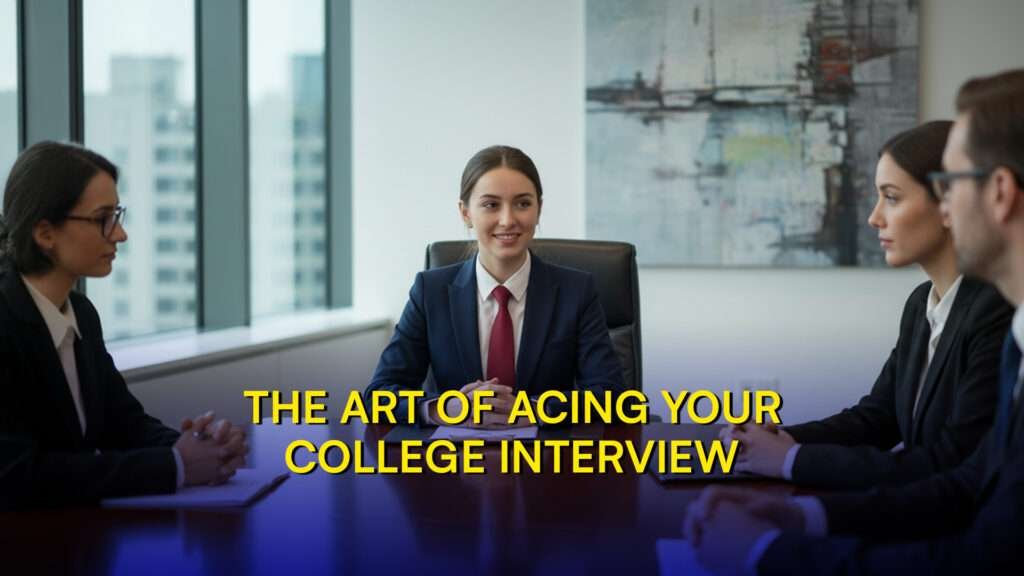
Let’s be honest, the college interview is one of the most nerve-wracking 20 minutes of the entire admissions process. You spend months polishing your essays, perfecting your activities list, collecting recommendation letters… And then suddenly, you’re expected to impress a complete stranger in a tiny Zoom window or a quiet campus office. And for what? A chance to show who you really are beyond grades and GPAs. But here’s the twist most students never realise: a college interview isn’t a test; it’s an opportunity. An underrated one. A deeply human one. And with the right preparation and some grounded, practical interview tips, you can turn those 20 minutes into the most memorable part of your application.
In this guide, I’ll walk you through everything from what to expect to how to actually sound like yourself (yes, that matters more than sounding “perfect”).
Ready? Let’s get into it.
Table of Contents
What Makes the College Interview So Important?
Here’s the thing most students misunderstand: a college interview is rarely about testing you. It’s about understanding you. A seasoned admissions officer once told me, “We already have your grades, your recs, your essays… the interview is just to see if the personality matches the paperwork.” That line changed everything for me. Because think about it, in a pool of thousands of applicants who all have great grades, strong extracurriculars, and polished essays, the interview becomes the one moment where you get to be a person, not a PDF. It’s the moment where they learn things like:
how you think
how you communicate
what excites you
how curious you are
whether you’d be a good fit for their campus
And honestly? You don’t need perfect answers. You just need real ones. But an interview alone won’t get you in. It’s one piece of a much bigger puzzle. Top universities don’t admit students solely for scores or eloquence; they admit a whole profile. Think of it as a combination of academic excellence, intellectual curiosity, meaningful work, and the personality you bring into the room.
Here’s what actually moves the needle at top-tier universities:
COMPONENT
WHAT IT MEANS
EXAMPLES OF WHAT TOP SCHOOLS LOOK FOR
Academics / Scores
Consistent rigor, top grades, strong test scores
Harvard admits often have 1500+ SAT / 34+ ACT range; Oxford expects high A-level/IB marks or board excellence
Essays / Personal Statement
Narrative, authenticity, purpose
A story that shows who you are, not just what you’ve done
Extracurriculars
Depth > quantity
Leadership in clubs, research roles, Olympics-level excellence, sustained impact
Awards/Achievements
Proof of excellence beyond classroom
Olympiads, national or international recognition, competitions, publications
Projects / Research
Initiative & intellectual depth
Research paper, tech build, business initiative, community project
Letters of Recommendation
Credibility & character endorsement
Teachers who know you beyond grades & highlight strengths with examples
Attending webinars, LOCI for deferred students, specific programme interest
The 20-Minute Pressure Cooker: Why Interviews Feel Scary
Twenty minutes. That’s shorter than an episode of Modern Family, shorter than your shower playlist, and yet somehow those twenty minutes feel like a pressure cooker where you’re expected to squeeze your entire personality, achievements, dreams, humour, and life purpose into one perfectly curated conversation. No wonder it feels terrifying. But here’s the truth no one tells you: a college interview isn’t a courtroom or an exam; it’s just a conversation. And the interviewer? They’re almost always rooting for you. Most of them volunteer their time because they genuinely enjoy meeting students. They want to walk away thinking, “I hope this kid gets in.” Once that sinks in, something shifts inside you. You stop trying to “perform” and start showing who you really are. You stop rehearsing scripted lines and start having real conversations. You stop hiding your quirks and start letting them breathe. Suddenly, those twenty minutes stop feeling like judgement and start feeling like a tiny doorway into the most human part of the admissions process.
Step 1: Preparing Without Sounding Over-Rehearsed
Let’s be clear about one thing: preparation does not mean memorising answers. That’s exactly how students end up sounding like Google search results or worse, like a glitchy version of ChatGPT. Real preparation is quieter and more personal. It looks like understanding your own experiences, knowing what moments shaped you, clarifying your motivations, and connecting those pieces to the school you’re interviewing for. It means practising lightly, not mechanically. One exercise I always recommend is the Three Story Rule: sit down and write three stories that genuinely define you. Maybe it’s the time you taught your grandma how to use WhatsApp, or the group project that completely fell apart but you somehow pieced back together, or the moment you finally realised what you want to study, or even the failure that changed you more than any shiny success ever could. These stories become your anchors, the moments you can return to when an unexpected question pops up. They remind you that you already have everything you need to sound authentic. You just have to trust your own experiences.
Step 2: Mastering the “Why This College?” Question
Ah yes, the question that haunts thousands of applicants every year. But here’s the secret: colleges aren’t looking for praise; they’re looking for alignment. They don’t want you to list adjectives like “world-class faculty”, “diverse community”, or “renowned reputation”; they’ve heard those phrases since the Stone Age, and they sound like recycled brochure text.
Instead, they want to understand why you care, why this college fits your story. The strongest answers come from specificity: the professor whose research genuinely excites you, the course that perfectly matches your academic curiosity, the student-led organisation you want to contribute to, or the campus value that feels like home. A simple test? If you could replace the college’s name with another and your answer still makes sense, it’s not specific enough. The goal isn’t to impress them with flattery; it’s to show them the puzzle piece alignment between who you are and who their community is built for.
Step 3: Telling Your Story (Without Monologuing)
Humans connect through stories, but interviewers don’t want a dramatic monologue that feels like a Netflix special. Think of storytelling as seasoning just enough to give flavour, not so much that it overwhelms the entire conversation.
You can use frameworks like STAR if you want structure, but the key is to keep it natural and conversational. Instead of slipping into corporate-sounding lines like, “I demonstrated leadership by delegating tasks,” talk about your experiences the way you would describe them to a friend – real, relatable, and a little messy.
For example, saying, “Our project was collapsing like a Jenga tower, and somehow I ended up holding the wobbliest piece,” instantly paints a picture and shows personality. That’s what interviewers remember: the colour, the humanity, and the honesty behind the story, not the overly polished version you think they want to hear.
Step 4: Body Language, Energy & First Impressions
You’d be surprised by how many strong applicants unintentionally sabotage their interview with low energy, crossed arms, a flat tone, and zero spark, as if they accidentally wandered in from a nap. A college interview isn’t just about the words you say; it’s about the feeling you create in the room. Your body language, your warmth, and your presence all matter.
Sitting upright but relaxed, smiling naturally, nodding to show engagement, and using your hands in a way that feels natural can shift the entire tone of the conversation. Even eye contact plays a role – enough to show confidence but not so intense that you look like you’re trying to read their mind. Interviewers remember the students who feel
Step 5: Questions You Should Ask (Mandatory!)
When interviewers ask, “Do you have any questions for me?” they’re not being polite, but they’re assessing your curiosity and your fit. This moment tells them whether you see this college as a living, breathing community or just another name on the list. The best questions are the ones that spark authentic conversation: asking what kind of student thrives on campus, or which class shifted the interviewer’s worldview, or how campus traditions shape the community experience. These types of questions show thoughtfulness, maturity, and genuine interest.
On the other hand, questions about cafeteria food, acceptance rates, or whether freshmen get single rooms land flat; they don’t reveal anything meaningful about you or your motivations. Your questions help define the interviewer’s final impression, so choose ones that reflect curiosity, not convenience.
Should You Still Interview If It’s Optional?
Here’s a little secret: most students underestimate that ‘optional’ rarely means ‘irrelevant’. When a college interview is optional, treating it as optional can actually put you at a slight disadvantage. Think about it: if two applicants look equally strong on paper, but one took the interview and the other didn’t, who do you think the admissions officer remembers more? The interview becomes your chance to add dimension to your application by adding your voice, your personality, and your excitement. Unless you physically cannot attend, you’re almost always better off saying yes. Even a decent interview shows engagement, maturity, initiative, and interest. And in competitive admissions, every signal of “I care” matters more than you realise.
What Not to Do (Ever)
There are a handful of mistakes that instantly weaken an otherwise strong interview, and most students don’t even realise they’re making them. Oversharing trauma, answering in resume language, or panicking when you stumble all create unnecessary pressure. Name-dropping rankings makes you sound like you care more about prestige than fit, while talking endlessly suggests you’re trying too hard to impress instead of trying to connect.
And of course, pretending to be someone you’re not or worse, lying, is not only unnecessary but also incredibly easy for interviewers to detect. The safest, smartest, and most effective rule you can follow is simple: be honest, be smart, and above all, be human. Interviewers don’t expect flawless answers. They expect sincere ones.
A Moment of Honesty: My Own Awkward Interview
Everyone has at least one interview disaster story, and mine still makes me cringe. I once answered “Tell me about yourself” with an accidental 10-minute monologue, the kind where halfway through, I even wanted to escape my own body. But that awkward experience taught me something important: interviewers aren’t looking for perfect delivery. They’re looking for authenticity. They forgive nerves. They forget minor mistakes. But they remember warmth, humour, curiosity, and sincerity.
It’s your vibe, not your vocabulary, that lingers in their mind long after the conversation ends. And that realisation is liberating; your interview doesn’t need to be flawless to be memorable.
Interview Day Checklist
The final stretch before an interview is all about grounding yourself, not overwhelming yourself. Hydrate, check your Zoom setup or travel route, dress neatly without overdoing it, and arrive a little early so you’re not rushed.
Keep your three-story anchors fresh in your mind – those experiences that define who you are and have at least two thoughtful questions ready to ask. And above everything, breathe. Seriously. A calm mind communicates better than an overprepared one. This simple rhythm sets you up for a conversation that feels natural, confident, and connected
Final Thoughts
A college interview isn’t a performance, but it’s a conversation. It’s your chance to step outside the polished paragraphs of your essays and show admissions officers the human being behind the application. The most effective interview tips are never about perfect phrasing or rehearsed answers; they’re about presence. About the small spark in your voice when you talk about something you care about, about the way you laugh at your own awkwardness, about the honesty in your pauses. You with your quirks, humour, curiosity, and imperfect charm are far more memorable than any scripted answer could ever be. And that’s exactly why authenticity always wins.
Want personalised mock interviews and expert feedback?
Book a free session with Rostrum and walk into your next college interview fully prepared and confident.
Q1. How long does a college interview usually last?
Most interviews run around 20–30 minutes, but alumni interviews can stretch to 45+ minutes if the conversation flows. Shorter interviews aren’t necessarily bad as some interviewers are just structured and efficient.
Q2. What are common college interview questions?
Expect classics like “Tell me about yourself”, “Why this college?” and “Describe a challenge you overcame.” They’re designed to understand who you are beyond grades, mainly your interests, personality, and thought process.
Q3. Can interviews make or break an application?
Not usually, but a strong interview can boost and humanize your application, especially if you connect well. A weak interview rarely ruins everything unless it’s extremely disengaged or inappropriate.
Q4. What if I get nervous?
Totally normal, and most students are. Take a breath, slow down, and speak at your pace; interviewers expect nerves and won’t judge you for pausing or thinking before answering.
Q5. Should I send a thank-you email?
Yes and it shows professionalism and gratitude. Keep it short, reflect on one part of the conversation you enjoyed, and gently reaffirm your interest in the college.
An alumnus of the London School of Economics and Political Science and a former consultant at PwC, Yatharth has empowered over 2,000 students from more than 20 countries to secure admissions at top institutions, including those in the Ivy League and University of Oxford and University of Cambridge.
An alumnus of the London School of Economics and Political Science and a former consultant at PwC, Yatharth has empowered over 2,000 students from more than 20 countries to secure admissions at top institutions, including those in the Ivy League and University of Oxford and University of Cambridge.